Ce blog est en cours de construction

>-------------------------------> VERSION FRANÇAISE cliquez ici <-------------------------<

REFRACTORS

They consist of 2 lenses :

  • the aperture or objective lense concentrates the light in a focal point
  • the eye piece lens projects this image on the retina of the eye
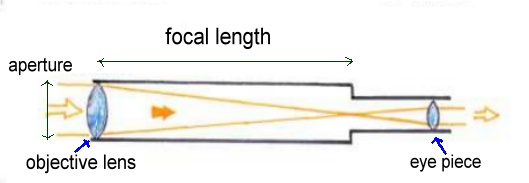


You can calculate the magnification of the telescope :

focal length (of the objective lense) / eye piece (focal length)

--> For example : a refractor with a focal of 700mm and an eye piece of 25 mm can magnify 700/25=28 times.

Though, there is minimal magnification. This is due to the diameter of the pupil that can reach at most 7-8mm when fully dilated in the dark.

Minimal magnification = aperture (diameter of the objective lens) /7 (diameter of the pupil) .

Maximal magnification = 2 to 2.5 times the aperture. More or less, the image is blurred.

So, you cannaot increase the strength of a telescope by just decreasing the eye piece. You need to have larger apertures for higher magnifications and longer focal lengths. This is why amateur refractors have limited magnification, elsewhere, the tube would be too long to be practical in use.

Refractors, since they refract light when it passes through their aperture, cause chromatic aberration : you see a rainbow of colors around the observed object, such as in this photo taken with our refractor of the planet Venus :


Associating 2 lenses together decreases this aberration.
There are also apochromatic refractors manufactured with high quality lenses with low refraction indice , but they are highly expensive.

Refractors have many advantages :
  1. They give a sharp image. They are great for observing planets, the moon and double stars. For the same aperture size, refractors are, while observing, 1 inch superior to reflectors. Since light is partly filtered through the lenses, refractors are not ideal for observing dark objects.
  2. They do not fear vibrations, their lenses stay aligned, which is why they are more practical for trips.

REFLECTORS

Developped by Sir Isaac Newton, thus also known as newtonian telescopes.

This configuration allows bigger apertures without longer tubes :
bigger aperture ==> more light assimilated ==> fainter objects are better viewed.

Since they depend on parabolic mirror to concentrate the light, they don't suffer from chromatic aberration.

The same magnification formulas as refractors apply. But since they give less sharp images then refractors, try to avoid getting too close to the maximal magnification allowed.

They have an inconvenient : the mirror focus can get displaced while moving the telescope, so collimation needs to be adjusted sometimes, or else you get an image with a trailer.

Refractors are great for faint objects, such as nebulae, specially when using a large aperture with lesser magnification.
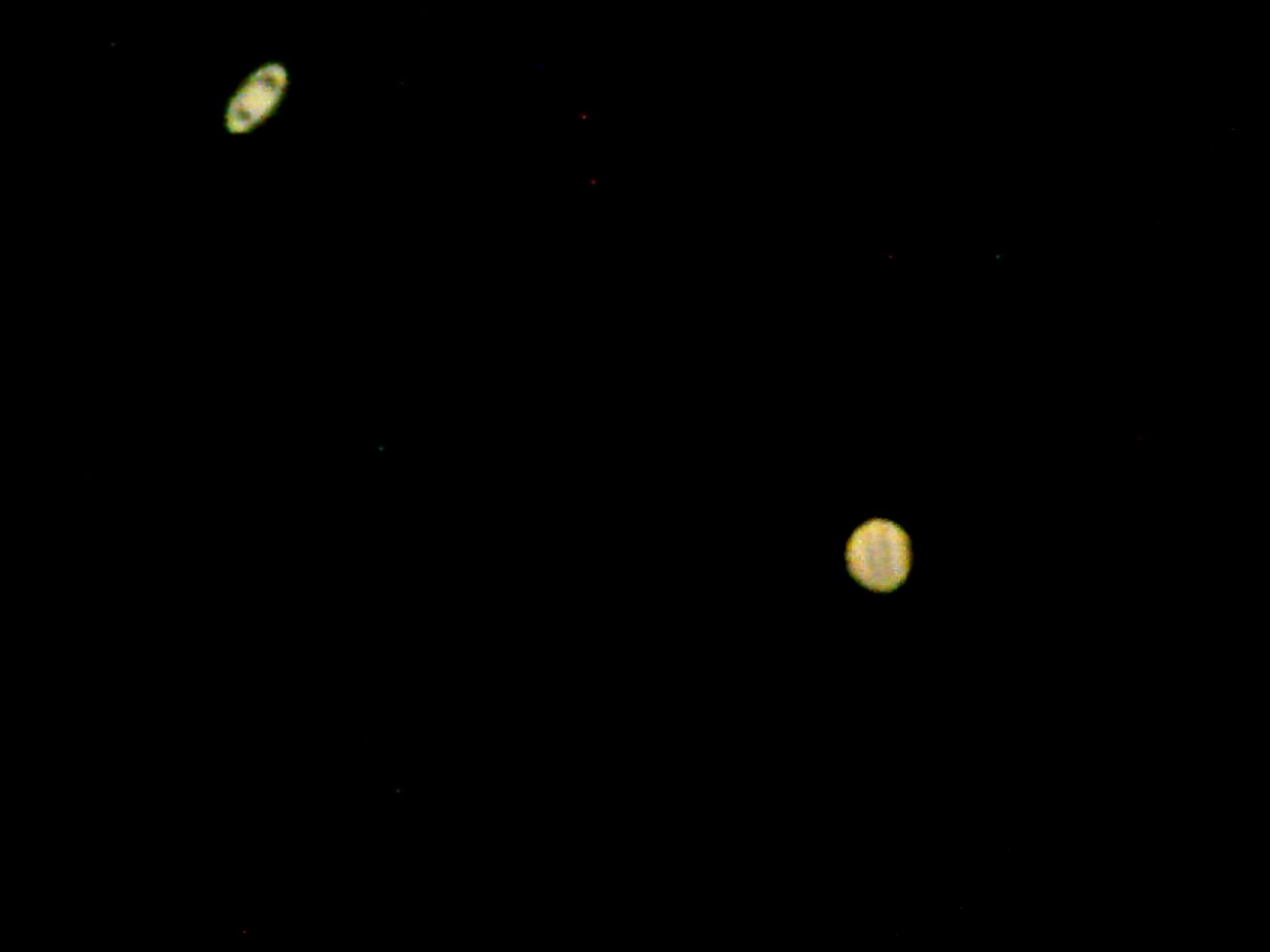
They are also good for planets, such as Jupiter and Saturn taken with our 4,5" reflector :


CATADIOPTRIC TELESCOPES

Also known as Schmidth-Cassegrain telescopes.
They are hybrid telescopes : they associate a spherical mirror (not parabolic) with a corrector lens (Schmidth lens) .
They are quite compact with a large aperture and a short tube.


Mainly usefull for astrophotography, allowing observation of any celestial object.

TELESCOPE MOUNTS


  • Alt-azimuth mount : the simplest and the less expensive : allows motion in 2 plans :

horizontal = azimuth


vertical = altitude


  • Equatorial mount : follows the celestial coordinates : the right ascension (parallel to the axis of the earth) and the declinaison (follows the rotation of the earth).

Once the right ascension is fixed, depending on the latitude of the observing site, the telescope can track the celestial object beeing observed, while rotating around the declinaison axis.


In any kind of mount, the choice should focus on 2 important notions :


  1. Stability : a feable touch should not cause it to vibrate.

  2. Height : must be adjustable.

ACCESSORIES

BARLOW LENS
In association with the eye piece, it increases the magnification up to 1,5 to 3 times.

A photo we took of Jupiter and Saturn without Barlow lens


And with a Barlow lens

FINDERSCOPE
Can be a small refractor or a simple "star pointer" , fixed in parallel with the tube of the telescope.

It needs to be adjusted before each observation session.
To do so, look at a bright sky object with low magnification.


MOTOR
In astrophotography, for exposure times of more then 10 seconds, motorised tracking of an equatorial mount is warranted, to counter the rotation of the earth.

FILTERS
  • SUN FILTERS

ALWAYS ON THE APERTURE !!!

Eye piece sun filters (sometimes given with low quality telescopes) are prohibited : they heat up, explode and may cause serious eye injury.

  • BLUE, ORANGE, RED, GREEN FILTERS

enhance details on the planets and the moon.


We took this photo of the moon without filter :


We added a green eye piece filter :

  • NEBULA FILTERS :

for deep sky observation, such as galaxies and nebulae.

They filter atmospheric light and enhance faint deep sky objects.

They can be used on binoculars and in front of an eye for naked eye observation.

There are 2 types :


  1. Broad band (LPF = Light Pollution Filter) : they filter a little bit of each light ray from the light spectrum, giving an image of inadequate contrast.
  2. Narrow band ( O-III , UHC = Ultra High Contrast, Deep sky filter) : very usefull, each is specific for certain types of nebulae or galaxies. But they filter too much light, thus decreasing the brightness of the image. Therefore, they should be used with larger apertures that allow more light in.